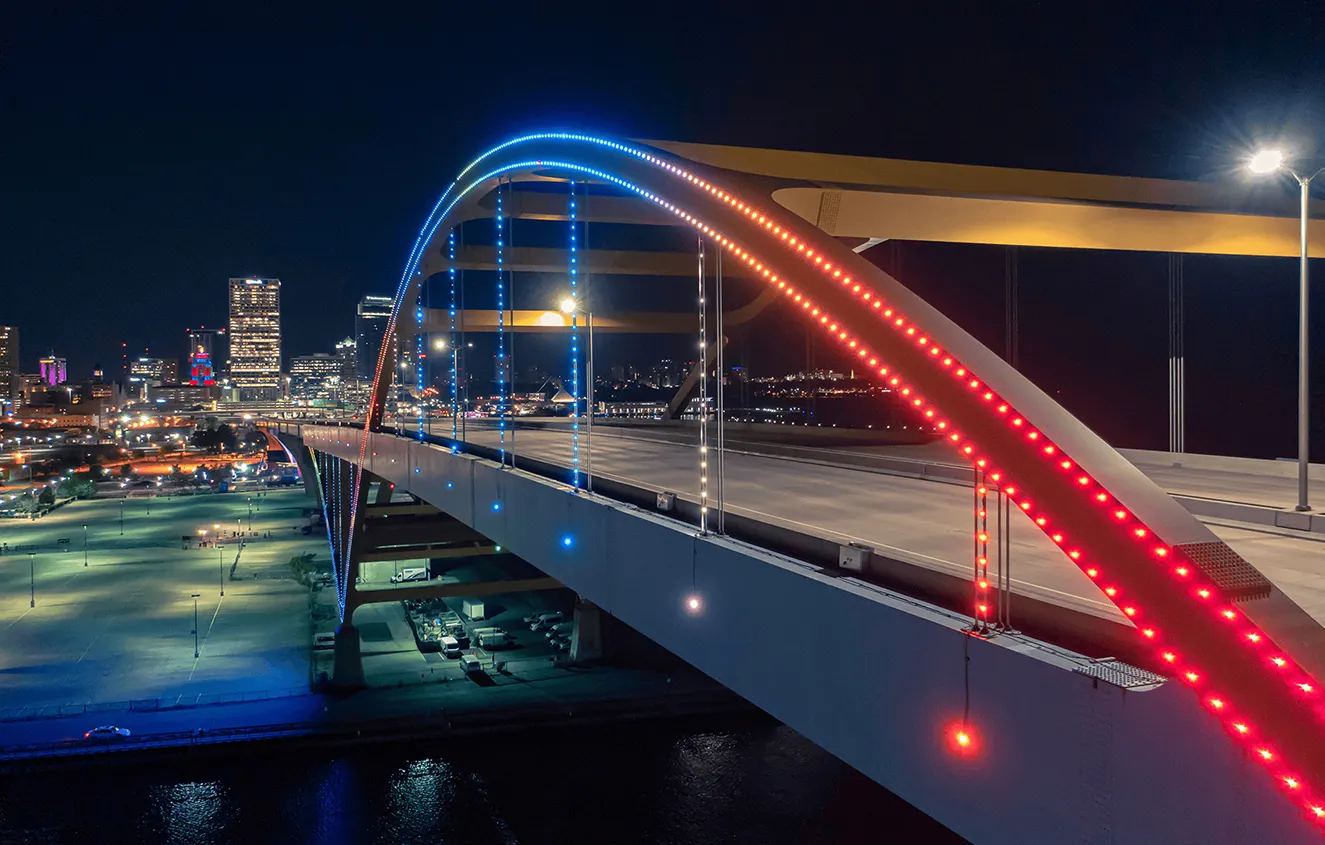
It takes more than electricity to light a bridge. That’s something Crafton Tull engineers learned firsthand when they were tasked with helping to illuminate the Daniel Hoan Memorial Bridge in Milwaukee, Wisconsin. The project involved creativity, real-world testing, and collaboration to produce a solution for lighting bridge without compromising its strength.
Paul Zimmerman, Vice President of the Koontz Electric Co. High Voltage Division, said when Koontz was awarded this project, they knew the biggest challenge was how to attach items to the bridge without drilling, tapping or welding. That’s when Koontz reached out to Crafton Tull’s Hot Springs office, which was then B&F Engineering.
Dustin Ward, P.E., S.E., a Vice President in Crafton Tull's Structural Engineering division, said affixing anything to a bridge must be done with extreme caution. Some bridges can have mechanical attachments, such as welded studs or bolted plates, but the Hoan bridge contains components that are considered “nonredundant steel tension members” (previously called “fracture-critical”), which meant it wasn’t that simple.
“With fracture-critical bridges, you don’t want to drill, tap, or do anything that could compromise structural integrity. Koontz floated the idea of using magnets for attachment. We’d experimented with magnets on the Hernando de Soto Bridge, but not to this scale.”
Dustin Ward, P.E., S.E., Vice President of Structural Engineering
Crafton Tull
Since magnets seemed like the best solution, Ward and his team got to work finding out exactly what type of magnet was needed for such a job. They built a testing apparatus and conducted in-house testing of three different strengths of magnets in both shear and tension.

“We tested how the magnets performed with paint thickness, adding extra layers beyond what was expected in the field, just to be conservative,” Ward said. “We also considered environmental factors. For example, magnets perform better in cold weather, which is important given Milwaukee’s winters.”
Ward and his team’s calculations accounted for self-weight of lighting components, atmospheric icing, wind, vibration, and impact loads. After testing, it was determined that the system had a safety factor close to five, well above the minimum of two that had been targeted.
“I calculated that even 30 pounds of force would have worked, but we wanted the extra safety factor,” Ward said.
Ultimately, the team selected 100-pound, pull-force fully encapsulated magnets with rubber membranes which would protect the bridge’s paint. Four magnets were used for each of the larger light assemblies. Single 100-pound magnets were used to support each of the Christmas-like programmable lights. UV-resistant cable ties were also used on suspension cables to hold other electrical components, which required their own calculations.
“I never thought I’d be doing engineering math on zip ties, but it worked,” Ward said.
Zimmerman said Crafton Tull provided an efficient solution and accurate calculations, which gave Koontz the confidence to proceed with a type of installation they had never done.

The first lighting of the Hoan Bridge took place in October 2020 and illuminated the west side of the bridge with fully programmable LED lights that can be lit a wide variety of colors. The lighting system includes more than 1,800 Color Kinetics FlexElite, RGBW nodes and nearly 50 Color Kinetics ArchiPoint iColor Powercore fixtures.
“It was an emotional moment for many, as the lights were seen as a symbol of hope for the community (during the pandemic). This project has become much more than just a lighting installation; it has become a part of the fabric of Milwaukee.”
Erika Smith, Executive Director
Light the Hoan
Lighting the Hoan was the culmination of years of public and private fundraising by a collective of local business and civic leaders who created the Light the Hoan group specifically focused on illuminating the bridge. The Light the Hoan website even offers a 24-7 live stream for anyone wanting to catch the moment the lights come on each evening: https://lightthehoan.com/hoan-bridge-livestream/
“The goal was to create a lasting and impactful installation that not only beautifies the city but also provides an opportunity for engagement through events and programming,” Smith said.
Over the years, Smith said the magnets have required minimal maintenance and there has only been one instance where a magnet was replaced and that was due to corrosion in a specific area near road level. Lubrication was added to prevent any future corrosion concerns.
“The use of high-powered magnets has proven to be a highly effective and innovative solution, ensuring the lighting system remains secure while preserving the integrity of the bridge,” Smith said. “The lights have withstood harsh winters, high winds, and heavy rains, and the stability of the lights has remained strong.”
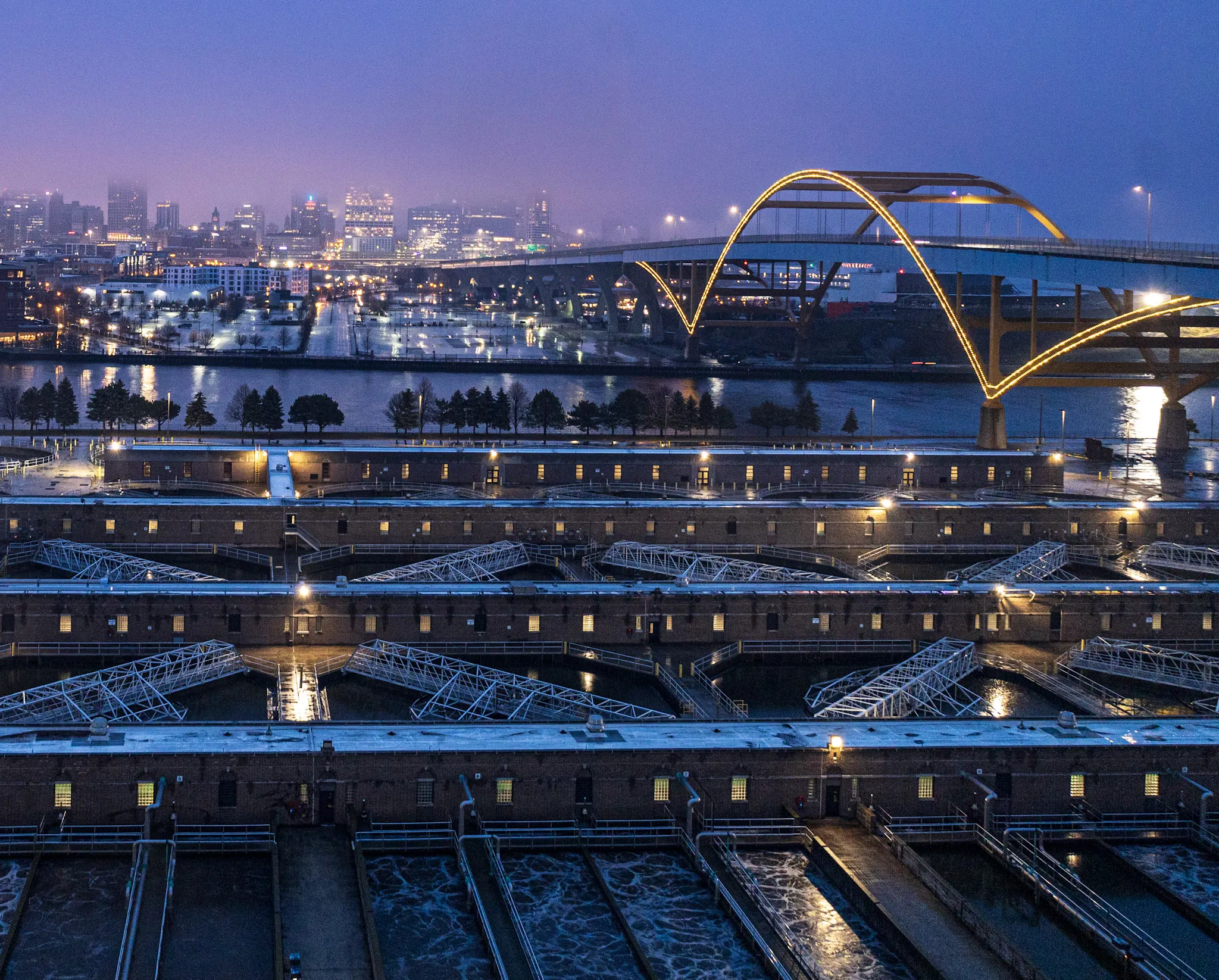
The east side of the bridge was illuminated in 2025 and mirrors the west side’s design with only minor adjustments to fit the unique needs of each section, Smith said.
“Looking back, it’s a great example of problem-solving under unusual constraints,” Ward said. “Even though our role was primarily in the first half of the installation, the engineering design carried through to the second half. It shows how a creative solution—magnets instead of drilling—can make a high-profile project both safe and successful.”
STORY BY WENDY JORDAN - MARKETING MANAGER